English
Slewing Bearing vs Ball Bearing: What Are the Key Differences?
Created on 08.21
Slewing Bearing vs Ball Bearing: What Are the Key Differences?
A practical comparison for buyers choosing the right rotation component
Guide from Anhui Yuanfeng

Quick Answer
A slewing bearing is a large-diameter rotation bearing (typically 200 mm to 6,000 mm) designed to carry axial, radial, and moment loads simultaneously while supporting a rotating platform. A standard ball bearing is a small, precision component (usually under 200 mm) that carries loads between two rotating shafts or between a shaft and housing. The differences in size, load type, mounting, and application are fundamental - choosing the wrong one means choosing the wrong machine.
◆
Key Takeaways
1. Size and structure: Slewing bearings are large ring assemblies with integral mounting holes and often gear teeth. Ball bearings are compact single components.
2. Load handling: Slewing bearings manage combined axial + radial + moment loads in one unit. Ball bearings primarily carry radial or axial loads in one direction.
3. Mounting: Slewing bearings bolt directly between two structures without a housing. Ball bearings need a housing and shaft fits.
4. Rotation speed: Slewing bearings rotate slowly (degrees per second). Ball bearings often run at thousands of RPM.
5. Application: Slewing bearings go into cranes, excavators, wind turbines, and rotary tables. Ball bearings go into motors, pumps, wheels, and gearboxes.
◆
What Is a Ball Bearing?
A ball bearing is a precision component made of an inner ring, an outer ring, and hardened steel balls between them, held in a cage. Its job is to reduce friction between two moving parts - typically a rotating shaft and a stationary housing. Ball bearings come in deep groove, angular contact, and thrust configurations, sized from a few millimeters to a few hundred millimeters.
They are designed for high-speed rotation and carry loads primarily in one direction: radial (perpendicular to the shaft) or axial (along the shaft). They are made in enormous volumes by automated production lines, which is why they are inexpensive and universally available.
◆
What Is a Slewing Bearing?
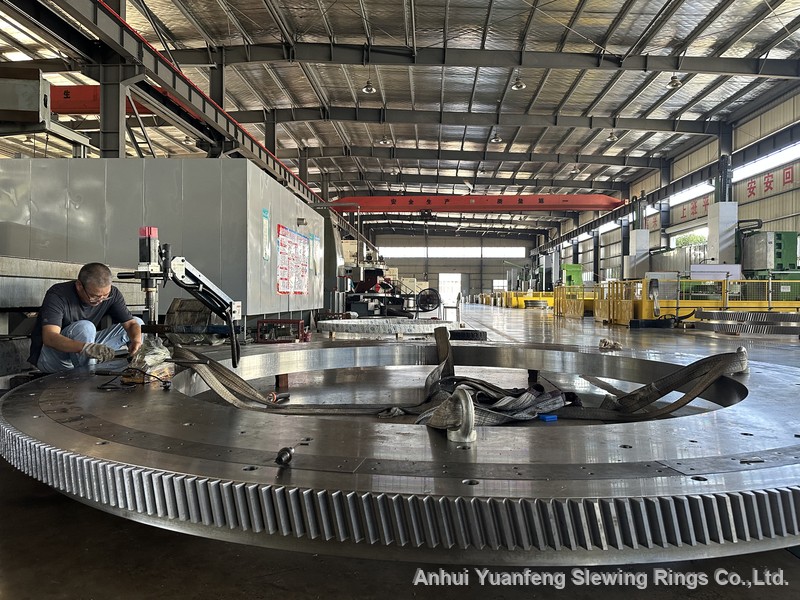
A slewing bearing (also called a slewing ring or rotary bearing) is a large-diameter bearing - commonly 200 mm to 6,000 mm - that supports a rotating platform while carrying loads from multiple directions at once. Unlike a ball bearing, it is a self-contained unit: inner ring, outer ring, rolling elements, mounting holes, and often gear teeth, bolted directly onto the structure with no separate housing.
Slewing bearings come in several internal configurations - single-row four-point contact ball, double-row ball, cross roller, and three-row roller - each tuned for different combinations of load, precision, and cost. They rotate slowly, typically a few degrees per second, but must absorb forces that would destroy a standard ball bearing instantly.

ide-by-Side Comparison
The practical differences at a glance
Aspect | Slewing Bearing | Ball Bearing |
Diameter range | 200 - 6,000 mm | Few mm - 200 mm typical |
Load directions | Axial + radial + moment simultaneously | Radial or axial, one dominant direction |
Mounting | Bolted between structures, no housing | Pressed into housing, shaft fit required |
Rotation speed | Slow, degrees per second | Fast, up to thousands of RPM |
Gear integration | Internal/external gear teeth available | Not available |
Typical applications | Cranes, excavators, wind turbines, rotary tables, radar | Motors, pumps, wheels, gearboxes, fans |
Production volume | Custom, low volume, made to order | Mass produced, off the shelf |
The one-sentence rule: If your application rotates a large platform under heavy combined loads at low speed, you need a slewing bearing. If it rotates a shaft quickly under a simple load, you need a ball bearing. They are not substitutes for each other.

Real Case: Where the Difference Shows Up
A concrete example from our own production: a customer building a beam transport vehicle for bridge construction needed a steering pivot bearing for a machine carrying 600-900 tonne girders. Each axle steering module had to support the vehicle's weight while rotating slowly under full load. This is a textbook slewing bearing application - the combined axial load and moment load would destroy any standard ball bearing in hours.
We supplied a 700 mm double-row ball slewing ring in 42CrMo steel with induction-hardened raceways (HRC 55-62), ground raceways, and a bolted mounting pattern matched to the customer's axle module. Every unit shipped with a Zeiss CMM inspection report. A standard ball bearing could not have carried the axial load, let alone survived the moment load from uneven terrain.
The reverse is also true: nobody would use a slewing bearing in a small electric motor. It would be oversized, slow, and absurdly expensive. Choosing the right bearing type starts with the application - not with the part.
◆
How to Decide Which One You Need
Ask yourself these questions before choosing:
1. What is rotating? A platform/table/turret (slewing) or a shaft (ball bearing)?
2. What loads are present? Is there a moment load (off-center force trying to tilt the bearing)? If yes, slewing bearing.
3. What speed? Slow rotation under load (slewing) or high RPM (ball bearing)?
4. What is the diameter? Above roughly 200 mm with platform mounting, you are in slewing bearing territory.
5. Do you need gear teeth? Slewing bearings can integrate internal or external gears - ball bearings cannot.
If you are still unsure, send your application details to a specialist manufacturer. At Anhui Yuanfeng Slewing Rings Co., Ltd., we produce slewing bearings from 200 mm to 6,000 mm in single-row ball, double-row ball, cross roller, and three-row roller configurations - and we are happy to confirm which type fits your machine.
◆
Frequently Asked Questions
Quick answers to common buyer questions
Q: Is a slewing bearing the same as a ball bearing?
No. A slewing bearing is a large-diameter (200-6,000 mm) rotation bearing that carries combined axial, radial, and moment loads, mounted directly between structures. A ball bearing is a compact component for shaft rotation carrying a single dominant load direction at high speed.
Q: Can a ball bearing be used instead of a slewing bearing?
Not for platform rotation. Ball bearings cannot handle the moment loads or the combined load directions that slewing bearings carry. Using one in a crane turntable or rotary table would cause rapid failure.
Q: What are the types of slewing bearings?
The main types are single-row four-point contact ball, double-row ball, cross roller, and three-row roller. Each balances load capacity, rigidity, precision, and cost differently for specific applications.
Q: How much does a slewing bearing cost?
Cost depends on diameter, type, material, gear configuration, and precision. Custom slewing bearings range from a few hundred to tens of thousands of dollars. Contact us with your specification for a quote.
Q: How long does a slewing bearing last?
With proper lubrication and sealing, slewing bearings typically serve 10-20 years in normal duty. Service life depends on load spectrum, environmental conditions, and maintenance discipline.
Choosing between bearing types? Leave a message - our engineers reply within 24 hours.
Contact
Leave your information and we will contact you.
电话
WhatsApp